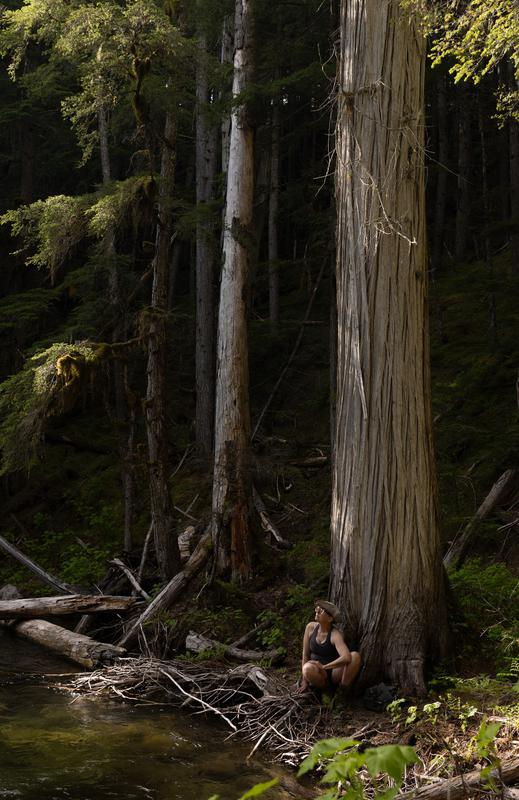
Rooted in the principles of spiritual ecology and informed by the Wildcraft Forest approach to Sanctuary Forests and Yasei Shinrin Yoku, this program invites participants to engage with land not as an observer, but as a participant in a living system of relationships. It offers a pathway into understanding how awareness, attention, and behaviour shape our connection to place—and how that connection can become the foundation for meaningful reconciliation.
Rather than presenting fixed answers, the program emphasizes practices of listening, humility, and presence. Participants are guided to spend time in their own local environments, learning to recognize layers of ecology, history, and meaning that exist within the landscapes they inhabit.
Through this process, reconciliation begins to shift—from something conceptual to something lived.
Participants often find that as they deepen their relationship with land, they also begin to reconsider their role within it—not as a user or visitor, but as someone capable of contributing to its ongoing care and renewal.
This is where healing begins: Not as an idea, but as a practice grounded in place.
Program Delivery
- Weekly PDF lessons grounded in Wildcraft Forest School principles
- Pre-recorded video teachings and guided field practices
- Live online circles for dialogue, reflection, and shared learning
- 12 structured exercises rooted in real-world, place-based application
Participants are expected to spend time outdoors in their own environment between sessions.
Curriculum (12 Core Areas)
1. Introduction to Spiritual Ecology in Practice
Introduction to Spiritual Ecology in Practice 2.Sanctuary Forest Principles as a Framework for Relationship
Sanctuary Forest Principles as a Framework for Relationship 3.From Observation to Participation: Shifting Awareness
From Observation to Participation: Shifting Awareness 4.Understanding Reconciliation Beyond Concept
Understanding Reconciliation Beyond Concept 5.Land as Teacher: Developing Place-Based Awareness
Land as Teacher: Developing Place-Based Awareness 6.Listening Practices: Silence, Stillness, and Attention
Listening Practices: Silence, Stillness, and Attention 7.Cultural Awareness and the Role of Humility
Cultural Awareness and the Role of Humility 8.Recognizing Layers of History in the Landscape
Recognizing Layers of History in the Landscape 9.Reciprocity: Moving from Use to Relationship
Reciprocity: Moving from Use to Relationship 10.Personal Responsibility in Ecological Systems
Personal Responsibility in Ecological Systems 11.Small Acts of Restoration (Ecological and Relational)
Small Acts of Restoration (Ecological and Relational) 12.Integrating Practice into Daily Life and Work
Integrating Practice into Daily Life and WorkThe 12 Practice Exercises
Each participant will complete 12 guided exercises designed to:
- Anchor learning in their local landscape
- Encourage personal reflection and articulation
- Translate ideas into observable action
Examples include:
- Sit-spot observation practice over time
- Mapping relationships within a local ecosystem
- Reflective journaling on personal assumptions about land
- Designing and implementing a small act of restoration
- Articulating a personal framework for reconciliation in practice
These exercises form a personal body of work, not just course completion.
Who Should Take This Program?
- Graduates or participants of Wildcraft in-person programs
- Educators and facilitators working with land-based learning
- Environmental practitioners seeking deeper relational frameworks
- Individuals exploring reconciliation in a meaningful, applied way
- Anyone drawn to spiritual ecology and place-based awareness
No prior technical knowledge is required—only a willingness to engage directly with place.
Program Fee & Format
Program Fee: $580 CAD
Format: Distance Learning (6–8 Weeks)
Includes:
- Full curriculum access
- Live sessions and recordings
- Guided exercises and reflection framework
- Participation in the Seasonal Learning System
Seasonal Learning Integration
This program is offered three times per year, each with a different emphasis:
- Winter: Awareness, listening, and personal reflection
- Summer: Direct engagement and applied practice
- Fall: Integration, responsibility, and refinement
Participants are encouraged to return in different seasons to deepen their understanding.
Connection to In-Person Training
This online program is not a replacement for the in-person experience.
It is:
- A preparation pathway
- A continuation of practice
- Or a stand-alone entry point into the Wildcraft Forest School approach
For those who later attend in-person training, this program provides a strong foundation in awareness, language, and practice.
Additional points to ponder...
- This work cannot be rushed or simplified.
- It asks for attention.
- It asks for humility.
- It asks for participation.
But for those willing to engage, it offers something increasingly rare:
A way to reconnect—with land, with responsibility, and with a deeper sense of belonging.
contact the forest
250.547.2001


distance learning
index
camp
programs
REGULAR REGISTRATION
Spiritual Ecology & Reconciliation Certification Training
Distance Learning Series Regular Cost: $580.00 (Canadian Dollars)
You may register using this secure Paypal link:
Yasei Shinrin Yoku
and Spiritual Stewardship
Nature is returning as a key element within the human spiritual experience. Don Elzer talks about how Yasei Shinrin Yoku delivers a practice where-by we create a working relationship with nature through stewardship.
Spiritual Ecology & Reconciliation
A Practice of Relationship with
Land, Culture, and Living Systems
Across many landscapes, there is a growing recognition that environmental degradation and cultural disconnection are not separate issues—they arise from the same underlying condition: a breakdown in relationship. Land has been treated as resource rather than relative, and in that shift, ways of knowing, respecting, and living with place have been diminished or lost.
At the same time, conversations around reconciliation are becoming more present in public life. Yet for many, reconciliation remains abstract—something discussed in policy, education, or acknowledgment, but rarely practiced in daily, place-based ways.
Healing Forests brings these two threads together.
Wildcraft
Forest School
You may also register by Interac or
Wells Fargo Transfer. Send us an email and we will send you instructions.
If you have questions please email us or call 250.547.2001

Yasei Shinrin Yoku Forest Therapy Index
Wildcraft Forest School - Online Programs